
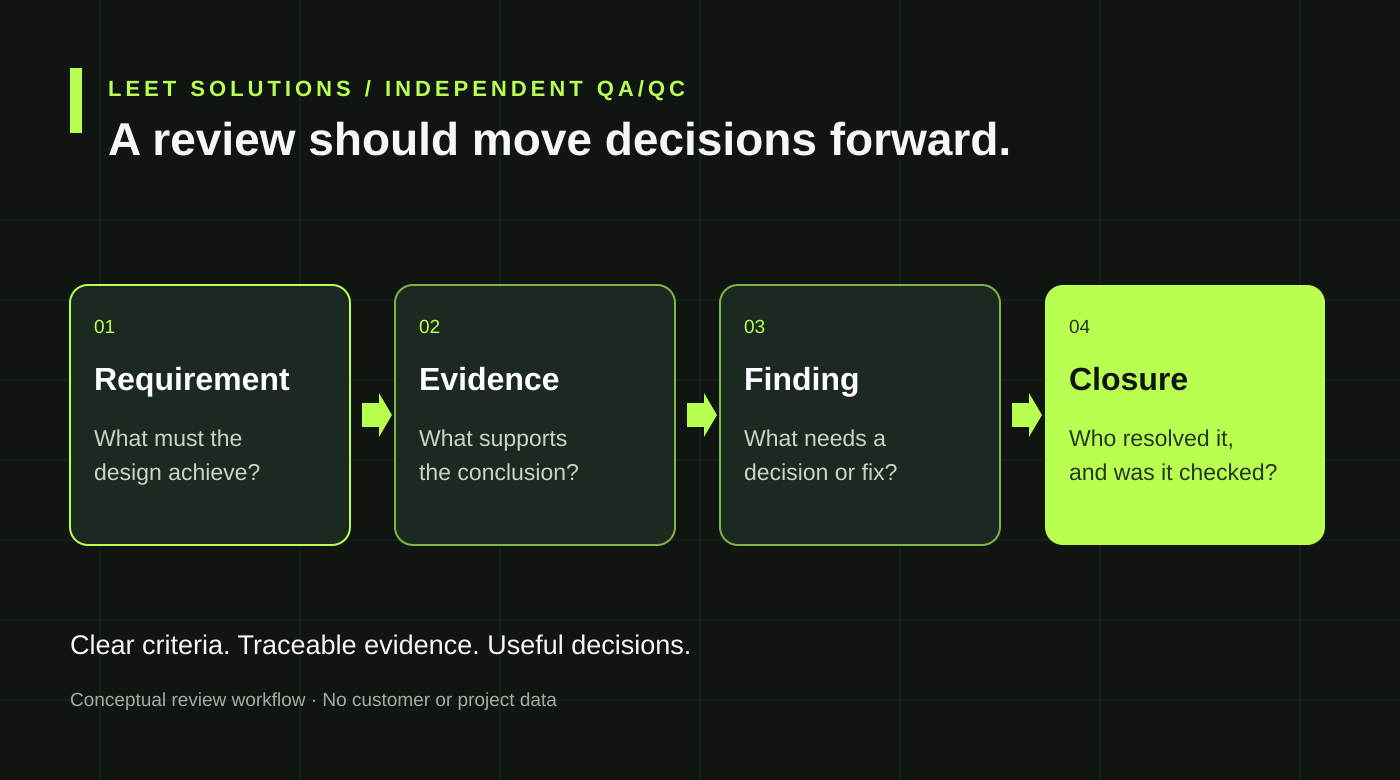
A wireless design review should leave the project team with decisions it can act on. “Looks good” is pleasant. It is also a remarkably expensive acceptance criterion when someone discovers the missing detail after the ceiling closes.
For an IT manager, MSP or integrator, the useful question is what an independent reviewer will check, what evidence supports the findings, and how unresolved issues reach a decision. The following is a practical review framework, not a universal certification standard or a promise that a document review proves live performance.
Start with an acceptance question
Define the decision before commissioning the review: release a design for installation, assess a proposed equipment substitution, or evaluate the evidence submitted at handover. Those are different jobs. A pre-installation review cannot certify measurements that have not happened yet.
Ask for a short review plan identifying the documents, revisions, requirements and exclusions. Name the person who can resolve conflicting requirements. Otherwise, the reviewer can spend valuable time comparing two diagrams that describe two different versions of the project. Neither diagram will admit it.
Make each requirement traceable
A useful review connects a stated requirement to a design decision and its supporting evidence. For example: which areas require service, which client and application requirements apply there, where the design addresses them, and what test will eventually demonstrate acceptance?
Cisco’s RF design service description includes requirements, capacity, installation limitations, antenna orientation and design assumptions. Those categories provide a useful cross-check, rather than a substitute for the project’s actual specification. The document describes Cisco’s service; it does not define a mandatory checklist for every WLAN.
Where the package has no agreed acceptance criterion, record that gap. Do not quietly invent one and grade the design against it. Likewise, distinguish a contractual requirement from vendor guidance and a reviewer’s preferred practice. They carry different weight when an installation decision is being made.
Review the joins between documents
Many worthwhile findings live between otherwise respectable documents. Check whether the AP identifier on the plan matches the schedule, whether the specified antenna matches the modeled configuration, and whether installation instructions describe the intended height and orientation.
Look for contradictory revisions, unexplained equipment substitutions and assumptions that never reached the installer. If an AP moves, ask which outputs need revisiting rather than updating only its drawing symbol. The review should tell the delivery team what changed and what remains dependent on that change.
This is a consistency check, not permission to replace a designer’s choices with the reviewer’s favorite hardware. A finding should explain the requirement or risk it addresses. Personal preference needs a label, not a red stamp.
Separate modeled, measured and untested claims
A reviewer should identify the evidence behind each conclusion. A prediction uses a model. A field survey records observations under stated conditions. An application test answers a narrower question about the tested devices, configuration and workload.
Cisco’s survey guidance distinguishes predictive, passive and active surveys. It notes that passive surveying does not associate the survey client with the AP and therefore lacks information available from an active connection. A report must not promote a passive RF result into proof of application throughput or uninterrupted roaming.
Ask the reviewer to label conclusions accordingly: supported by the supplied model, supported by measurements, or not established by this scope. “Not tested” is useful information. Hiding it beneath a successful-looking summary is not.
Include the supporting network and security scope
Before work begins, specify whether the review includes switching, uplinks, PoE, authentication and segmentation, or only the RF design. If another team owns an interface, identify the evidence and decision needed from that team instead of assuming its portion will be fine.
NIST SP 800-153, published in 2012, frames WLAN security across design, deployment, maintenance and monitoring. It is a useful lifecycle reference, not a current product-configuration recipe or a stand-alone compliance certificate. Security findings should cite the applicable organizational requirement and current guidance for the actual platform.
Use an agreed transfer method for authorized project material. Passwords, private keys and unrestricted configuration exports do not belong in an initial inquiry. An independent review does not require an independent collection of everybody’s secrets.
Require findings that someone can close
A useful issue record should contain:
- A unique identifier and the affected document revision or location.
- The requirement, observed discrepancy and supporting evidence.
- The likely operational or delivery consequence, without invented certainty.
- A proposed correction or decision, an owner and a closure condition.
Agree severity definitions before the report arrives. A numbering typo and an unresolved installation dependency should not look equally urgent simply because both received red highlighting. Where the consequence is uncertain, explain what additional evidence would resolve it.
An illustrative finding might read: “The drawing and AP schedule specify different antenna models. Confirm the intended model, reconcile both documents and reassess affected predictions before release.” That gives the team a concrete route to closure without pretending a reviewer has already established the RF impact.
Budget for the return pass
Agree whether the engagement includes reviewing responses and revised documents. Request a final disposition for each finding: corrected and rechecked, accepted by the authorized decision-maker, deferred with an owner, or unresolved. Keep the reviewed revision identifiable.
That small discipline makes the report useful beyond the meeting where everyone nodded. It also prevents “we changed it” from being mistaken for “the change was checked.”
Scope an independent review
Leet Solutions offers network architecture and QA/QC services, including engineering peer review and deployment documentation. Active and roaming tests require a separately agreed scope; hardware, cabling and installation are separate unless the written scope includes them.
Start an engineering-review inquiry with the project stage, the decision you need to make and a general description of the available evidence. If you are commissioning a new model rather than reviewing an existing package, begin with our remote predictive-design intake checklist.